
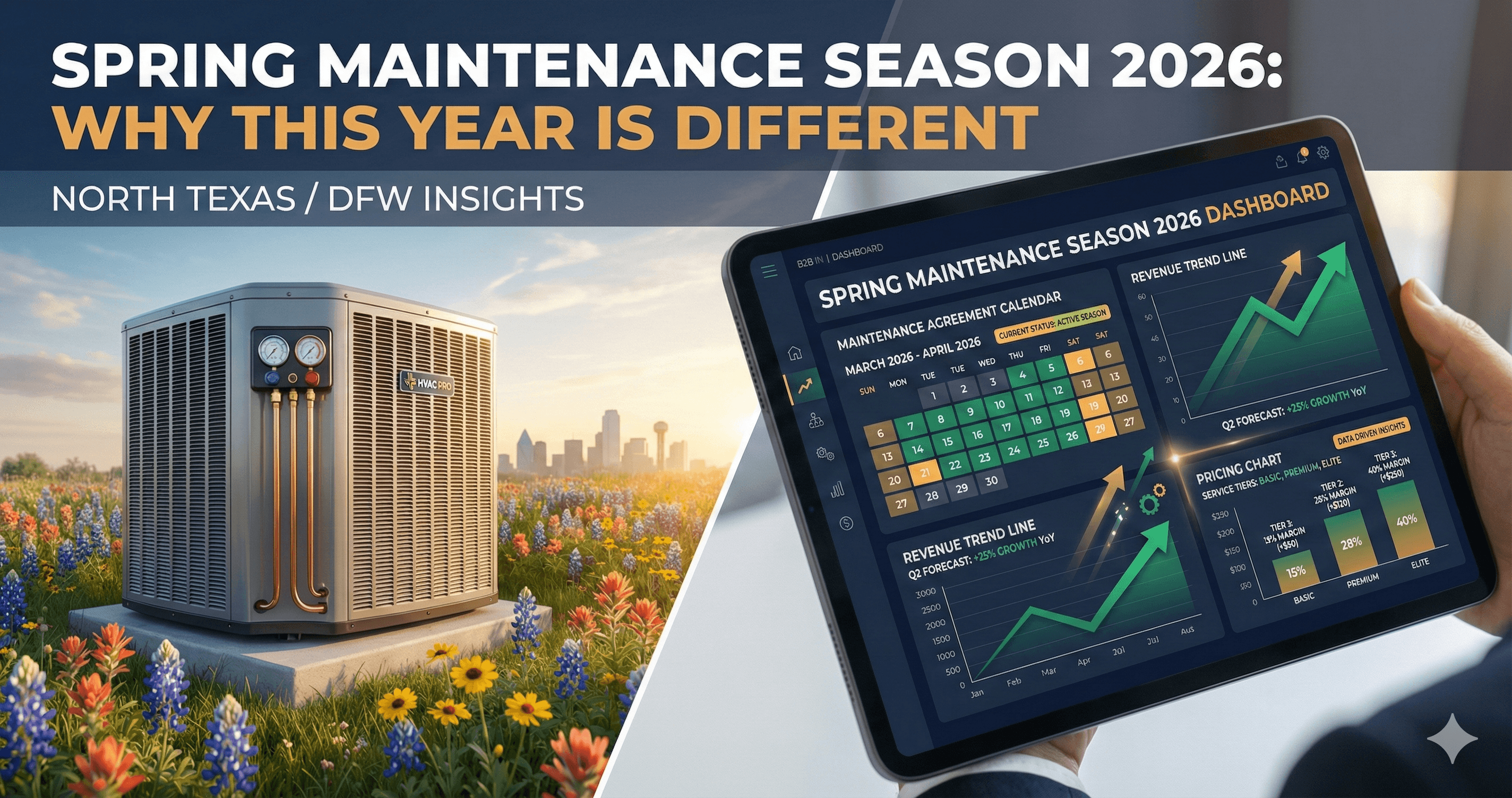
Time-Sensitive for DFW Contractors
Spring demand hits North Texas hard and fast. DFW homeowners typically schedule maintenance calls between March and early May before summer heat sets in. Contractors who lock in agreements now capture the recurring revenue. Those who wait compete on price during the peak rush.
Something shifted in the HVAC market between 2023 and 2026. Equipment prices that doubled between 2019 and 2023 have homeowners holding onto older systems longer than ever before. A homeowner who would have replaced a 12-year-old unit in 2021 is now asking: “Can we squeeze another few years out of it?”
The answer — for most units — is yes. And the contractor who does that annual tune-up, catches the failing capacitor before it becomes a midnight emergency call, and converts that homeowner into a maintenance agreement subscriber is the contractor who wins.
Spring 2026 is a window. Here's how to price it, package it, and not leave it on the table.
Why 2026 Is a Different Spring
Three forces have converged to make spring maintenance more valuable than it's been in years:
1. Replacement hesitation is at a 10-year high. Equipment costs remain elevated. A mid-tier 3-ton system that ran $3,200 installed in 2019 now runs $5,800–$7,400 depending on efficiency rating and refrigerant type. Homeowners aren't buying unless they have to. That means they're maintaining.
2. The R-22 phase-out hangover is real. Millions of older R-22 systems are still running in North Texas. Owners of those systems can't use cheap refrigerant to prop them up anymore, so they're investing in keeping mechanical components healthy instead. Maintenance tune-ups on these systems are more valuable — and more billable — than ever.
3. Maintenance agreements have become a financial lifeboat. Homeowners who can't afford a new system want the peace of mind that comes from a service agreement. For $15–$25/month, they get two annual tune-ups, priority service, and a discount on repairs. For the contractor, that's $180–$300/year in guaranteed recurring revenue per household, plus the pull-through work that comes with being the first call when something breaks.
The Numbers Behind Spring Maintenance
$287
Average spring tune-up ticket
DFW market, single-system
62%
Convert rate to agreement
When pitched on the job
$240/yr
Average agreement value
Per household, recurring
3.2x
Pull-through revenue multiplier
Agreement vs. non-agreement
Run the math on your own shop. If you do 200 spring tune-ups and convert 60% to maintenance agreements, you've added 120 recurring agreements at $240/year each. That's $28,800 in annualized recurring revenue from a single spring season. And that number compounds — each of those 120 households renews the next year, brings in pull-through repair work, and refers neighbors.
Contractors who have been building their agreement base for 3–5 years often find that 30–40% of their annual revenue comes from the agreement customer base. That's revenue that doesn't depend on the phone ringing.
How to Price Spring Maintenance in 2026
Many DFW contractors are still pricing spring tune-ups based on 2021 or 2022 comp tables. That's a mistake. Labor costs, fuel, and parts have all moved. Here's a framework for pricing that holds margin while staying competitive:
Single-System Tune-Up: $189–$249
The “inspection only” era is over. Your spring tune-up should include a 22-point checklist, refrigerant check, capacitor test, coil cleaning, and a written findings report. Price accordingly. Contractors who are charging less than $189 for this scope in 2026 are subsidizing homeowners and burning out their techs.
The upsell conversation: A $189 tune-up that uncovers a failing capacitor ($45 part, $120–$150 repair) is a $339 ticket. Your tech should have that conversation on every call. Not as a sales pitch — as a service. “We found this on your inspection. Here's what it means and what it costs to fix today vs. when it fails at 11 PM in July.”
Two-System Tune-Up: $299–$379
Multi-system homes represent a significant portion of DFW residential properties, especially in the $400K–$800K range where square footage requires two units. Don't price two-system tune-ups as two singles with a small discount — the drive time is the same, the dispatch cost is the same. Discount the second unit by 20–25%, not 50%.
Maintenance Agreement Enrollment: $180–$300/year
Structure your agreement to include two annual visits (spring and fall), priority scheduling, and a 10–15% discount on parts and labor. The key pricing principle: the agreement should be priced so that a homeowner who uses both tune-ups barely breaks even on the agreement cost vs. paying per-visit rates. They win on priority service and peace of mind. You win on retention and pull-through.
2026 Maintenance Agreement Pricing Tiers
Essential
$180/yr
$15/mo
- 2 seasonal tune-ups
- Priority scheduling
- 10% parts & labor discount
Entry-level, R-22 systems
Comfort
$240/yr
$20/mo
- 2 seasonal tune-ups
- Priority scheduling
- 15% parts & labor discount
- 1 free service call/yr
Most residential accounts
Premium
$300/yr
$25/mo
- 2 seasonal tune-ups
- Guaranteed same-day service
- 20% parts & labor discount
- Unlimited service calls
Premium homes, 2+ systems
Converting Tune-Up Customers to Agreements: The 3-Touch Approach
The highest-converting maintenance agreement pitch happens in three moments — not one. Most contractors pitch the agreement once, at the end of the call. Top performers work three touches:
Touch 1 — Dispatch confirmation (before the call): When confirming the appointment, your CSR mentions: “Our tech will also walk you through our maintenance plan options if you're interested — a lot of customers find it ends up paying for itself.” Seeds the idea. No pressure.
Touch 2 — Tech findings presentation (during the call): After the 22-point inspection, the tech walks through findings and says: “Everything's running well. Your capacitor is showing some wear — it's at about 60% rated capacity. We'll keep an eye on it. This is exactly the kind of thing we catch early for customers on our maintenance plan.” The agreement is positioned as what just happened, not as a sales pitch.
Touch 3 — 48-hour follow-up (after the call): Automated SMS or email: “[Customer name], just checking you're staying cool! Quick reminder — if you want to lock in priority scheduling and your 15% discount on that capacitor when you're ready, our Comfort Plan is still available. No contract, cancel anytime.”
Contractors using all three touches report 55–65% conversion rates on spring tune-up customers. Those using only the on-site pitch average 25–35%. The difference is the 48-hour follow-up — most shops never do it.
Technology for Automated Renewals
The biggest operational mistake in maintenance agreements isn't pricing — it's churn. Industry data shows 11% annual maintenance agreement churn for contractors with no automation, and 4–6% for those with automated renewal workflows. On a base of 300 agreements, that's the difference between losing 33 customers or 12–18 customers per year.
Both ServiceTitan and Housecall Pro have built-in agreement management with automated renewal reminders. The problem is most shops configure the software but never set up the notification sequences. Here's the renewal automation that works:
- 90 days before renewal: Email with agreement summary (“Here's what your plan covered this year”)
- 60 days before renewal: Renewal offer with early-bird pricing ($15 off if renewed by a specific date)
- 30 days before renewal: Direct call from CSR to confirm renewal and schedule spring visit
- 14 days before expiration: SMS reminder with one-click renewal link
- Day of expiration: Final email with 7-day grace period offer
Contractors who implement this sequence see renewal rates of 88–94%. Those who do nothing see 72–78%. The 10–16 percentage point difference on a 300-agreement base at $240/year is $7,200–$11,500 in retained annual recurring revenue — from automation that takes a few hours to set up once.
Financing Integration: The Underused Lever
Spring 2026 is the season to start offering financing for maintenance work — not just equipment. Here's why: a homeowner who can't afford to replace their 15-year-old unit can afford to maintain it, especially if they can spread the cost of a bigger repair or a multi-year prepaid agreement over 12 months at 0% interest.
GreenSky, Synchrony, and Service Finance all offer contractor-facing tools for same-day financing approval. The mechanics are simple: tech presents a $450 repair estimate, offers financing on the spot, homeowner approves in 90 seconds, you collect same day. For a contractor doing 15–20 service calls per week, adding financing to the technician conversation typically increases average ticket by 18–22%.
The maintenance agreement angle: offer a 3-year prepaid agreement at a 10% discount, financed at 0% for 12 months. A $240/year plan becomes a $648 prepaid for $583 (10% off), financed at $48.58/month. The homeowner locks in pricing protection. You collect 3 years of revenue upfront. Net working capital improves. Everyone wins.
From 187 to 340 Active Agreements in One Spring Season
A mid-size Plano HVAC contractor entered spring 2025 with 187 active maintenance agreements. They implemented three changes: repriced their plan tiers (Essential/Comfort/Premium), added the 3-touch conversion sequence, and set up automated 90/60/30-day renewal reminders in ServiceTitan. By the end of May 2025, they had 340 active agreements — an 82% increase in 10 weeks.
Active agreements
Tune-up conversion rate
Recurring agreement revenue
Your Spring 2026 Action Plan (By February 28)
You have roughly 3–4 weeks before the first wave of North Texas spring calls hits in mid-March. Here's what to complete before then:
- Review and update your current tune-up pricing against the 2026 framework above
- Set up your three maintenance agreement tiers in ServiceTitan or Housecall Pro
- Brief your CSRs on the 3-touch conversion language
- Configure automated 90/60/30-day renewal reminders for any agreements expiring in the next 90 days
- Apply for contractor financing account with GreenSky or Service Finance if not already set up
- Create or update your spring tune-up offer in your CRM for outbound marketing
- Launch your spring maintenance email/text campaign to previous customers
- Audit your existing agreement base for renewals due in March–May
- Set KPI targets: conversion rate, new agreements by April 30
The Revenue Math: Why Spring Is the Highest-ROI Quarter for Maintenance
Consider two DFW HVAC contractors with the same revenue base — $2.5M annually, 12 techs:
Contractor A treats spring tune-ups as one-time service calls. Average ticket $189. 250 tune-ups in the spring season. Revenue from spring tune-ups: $47,250. No agreement conversions tracked. By July, those 250 customers have scattered — some call back, most use whoever answers first.
Contractor B uses the 3-touch conversion approach. Average ticket $212 (includes more found repairs from the full inspection process). 250 tune-ups. Converts 58% to maintenance agreements at $220/year average. Revenue from spring tune-ups: $53,000. New recurring agreement revenue added: $31,900/year. Pull-through repair revenue from those 145 agreement customers over the next 12 months (at 3.2x multiplier on agreement vs non-agreement spending): estimated $46,400.
Same 250 calls. Same 12 techs. Different approach to conversion, pricing, and follow-up. Contractor B generates roughly $77,000 more in the 12 months following that spring season than Contractor A.
That's not magic. That's the compound effect of treating spring maintenance as a relationship-building season instead of a revenue-per-call season.
The Bottom Line for North Texas Contractors
Spring 2026 is not a typical maintenance season. Homeowners are more motivated than ever to maintain what they have. Replacement hesitation is at a decade high. The window to build recurring revenue through maintenance agreements is wide open.
Contractors who price their spring tune-ups correctly, train their techs on the 3-touch conversion approach, and automate their renewal sequences will come out of summer with a materially stronger business — more recurring revenue, lower churn, higher average tickets.
Contractors who price the same as 2022 and treat every tune-up as a standalone call will work just as hard and wonder why margins keep shrinking.
The season is coming. The question is how you show up to it.
Related Articles
North Texas Operations
We help DFW HVAC contractors identify and recover revenue leaks through operational monitoring and data analysis. Our clients stop leaving money on the table — without adding headcount or overhauling their tech stack.