Why 25% of Your HVAC Maintenance Agreements Won't Renew (And the $50K+ Revenue Impact)
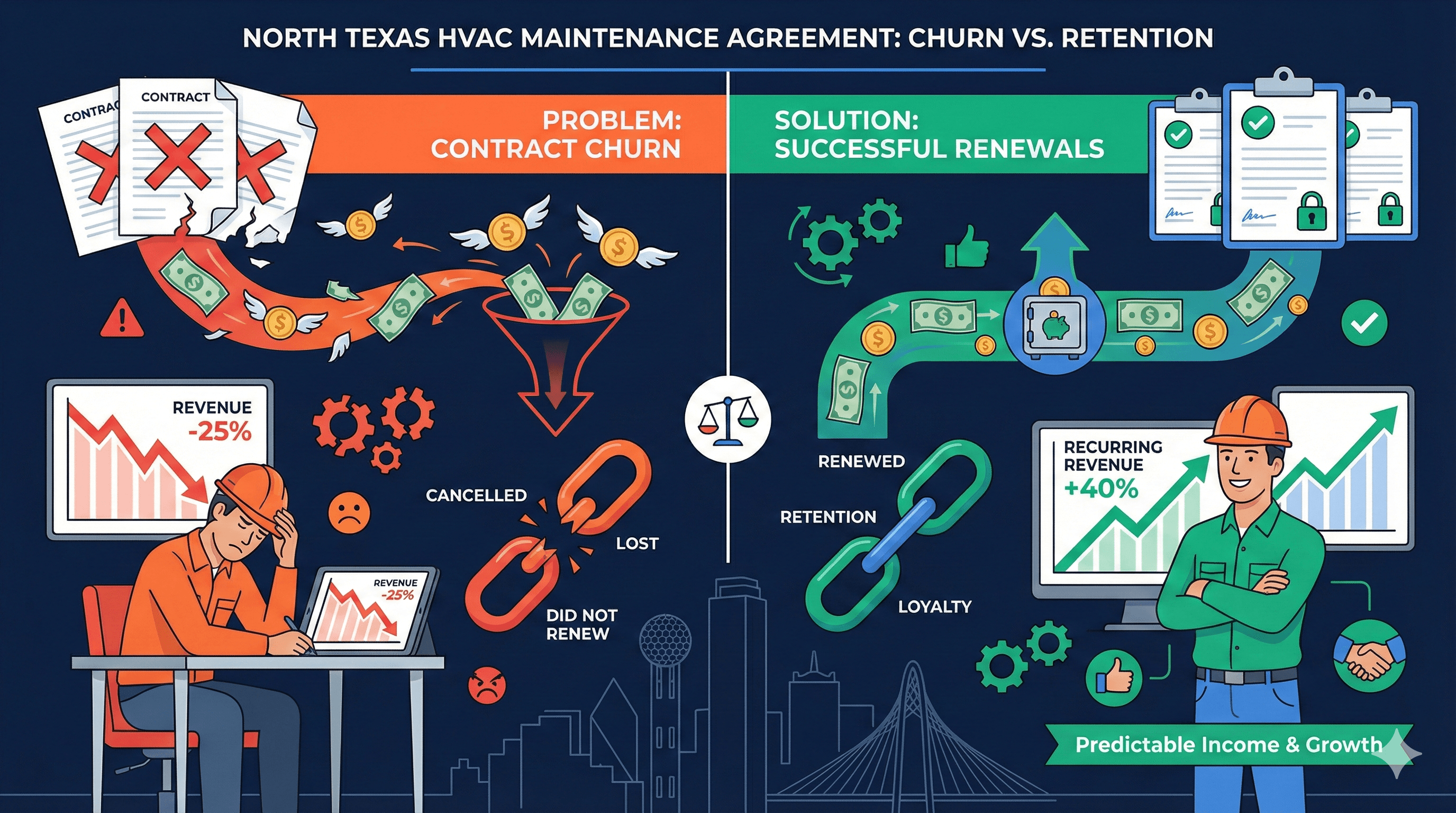
You sold 500 maintenance agreements last year. Great. But if you're like most North Texas HVAC contractors, 100-150 of those customers won't renew. That's $25,000-$37,500 in recurring revenue gone—plus $50,000-$112,500 in lost pull-through work you'll never see.
The Recurring Revenue Leak Nobody's Tracking
Most HVAC contractors celebrate when they hit their maintenance agreement sales goals. 500 contracts at $250 each = $125,000 in recurring revenue. The sales team gets bonuses. The owner projects next year's cash flow.
But here's what almost nobody tracks: How many of those 500 actually renewed?
Industry data shows the average contractor loses 11% of their customer database annually. For maintenance agreements specifically, churn rates range from 10-25% depending on operational efficiency. That means even if you sell 500 new contracts this year, you might only have 375-450 active contracts next year.
The Compound Revenue Loss
Starting with 500 maintenance agreements at $250/year ($125,000 annual revenue):
- Year 1: 15% churn = 75 lost contracts = $18,750 lost
- Year 2: 15% of 425 remaining = 64 lost = $16,000 lost
- Year 3: 15% of 361 remaining = 54 lost = $13,500 lost
- After 5 years: Only 222 of original 500 remain (55.6% lost)
Total 5-year revenue loss: $347,500+ from the original 500 contracts
Plus lost pull-through revenue: At a conservative 2:1 multiplier, that's another $695,000 in repairs, replacements, and upgrades you'll never see.
Why Maintenance Agreements Are the Profit Engine
Before we dive into why customers don't renew, let's establish why retention matters so much:
The Revenue Multiplier Effect
Maintenance agreements aren't just $250/year in recurring revenue. They're a customer relationship anchor that generates 2-3x additional revenue:
- Preventive maintenance contracts: 39% of total HVAC revenue industry-wide
- Pull-through work: $1-$3 in additional revenue per $1 of contract value
- Replacement conversion: 59% of homeowners who buy new systems call their maintenance contractor first
- Customer lifetime value: Maintenance customers worth 25% more than one-time buyers
- Profit margins: Service work has much higher margins than installation
Case Study: The Real Cost of 15% Churn
Starting point: $250,000 annual maintenance contract revenue (1,000 contracts × $250)
15% annual churn: 150 contracts lost = $37,500 in contract revenue
Pull-through revenue lost: $37,500 × 2 multiplier = $75,000
Total Year 1 Impact: $112,500 lost revenue
That's more than most contractors spend on marketing annually—evaporating because customers aren't renewing.
The #1 Reason Customers Don't Renew (It's Not Price)
When contractors lose maintenance agreements, they usually assume it's because of price. "Competitors are cheaper." "Customers don't value the service."
The data tells a different story: Only 21% of HVAC customer complaints are about price. Meanwhile, 38% complain about communication and procedural problems—scheduling trouble, lateness, lack of updates.
The Killer Pattern:
Contract sold → Payment collected → Service NEVER scheduled → Customer realizes 18 months later they haven't seen you → Cancels and feels ripped off
This is the #1 operational failure driving maintenance agreement churn. The customer didn't cancel because you're too expensive. They cancelled because you took their money and disappeared.
The irony? This is a 100% preventable operational problem, not a pricing or value problem. Yet it's costing North Texas HVAC contractors millions annually.
The 7 Reasons Customers Don't Renew (Ranked by Impact)
Reason #1: You Sold the Contract But Never Scheduled Service
The Problem: Sales team closes the deal, payment is collected, then... nothing. The contract sits in ServiceTitan but no one actually schedules the first tune-up. Months pass. Customer waits. Eventually they realize they've been paying for service they never received.
Why It Happens: No clean handoff between sales and operations. Humans get sick, busy, and burn out when manually scheduling hundreds of contracts. Spreadsheet-based tracking creates errors. Nobody owns the follow-through.
Customer Perspective:
"I paid $250 for maintenance in June 2024. It's now January 2026. They never called me once. I just cancelled my automatic renewal. I feel like I was scammed, and I'll tell all my neighbors."
The Fix: First maintenance visit must be scheduled at the point of sale or within 7 days. Automate the process so it's impossible for contracts to fall through the cracks.
Operational Standards:
- First service scheduled within 7 days of contract sale
- Automated workflow triggers when contract is signed
- Dedicated maintenance coordinator owns scheduling
- Monthly audit: Any contract >30 days without scheduled service?
Reason #2: Long Wait Times for Service (Even With a Contract)
The Problem: Customer calls for service in July. Gets told "we can get you in 3 weeks." They have a contract—why are they waiting like a non-contract customer?
What Customers Expect: Priority scheduling. Same-day or next-day service for non-emergencies. 24-hour emergency response. That's why they bought the contract.
Value Perception Breakdown:
Customer realizes they can get service just as fast—maybe faster—by calling 3 different contractors and taking the first available slot. The contract has no actual benefit.
Result: "Why am I paying $250/year for this?"
North Texas Context: With 500+ licensed contractors in DFW, customers have options. If you can't deliver fast service during peak season, someone else will.
Solution:
- Guarantee 24-hour or same-day service for contract customers
- Reserve capacity slots specifically for maintenance contracts
- Contract customers jump the line during busy periods
- Communicate wait times honestly and deliver on promises
Reason #3: Inconsistent Technician Assignment
The Problem: Different tech shows up every time. Customer has to re-explain their system quirks. New techs don't know the history. Relationships never form.
What Research Shows: Customers on maintenance plans are 70-80% more likely to purchase replacement systems from the same company—but only if they trust the company. That trust comes from consistent technician relationships.
The Turnover Compounding Effect:
High technician turnover disrupts customer relationships and increases service inconsistency. When your best tech leaves and takes 20 customer relationships with him, those contracts are at immediate risk of non-renewal. Learn more about the $30K-50K cost of tech turnover and its impact on contract retention.
Best Practice:
- Assign consistent technicians to maintenance routes
- Geographic routing keeps same tech servicing same area
- When tech changes are unavoidable, warm handoff with introduction
- Track customer satisfaction by technician assignment
Reason #4: Perceived Lack of Value (Nothing Ever Wrong)
The Problem: Tech shows up twice a year, changes filter, checks refrigerant, says "everything looks good," leaves. Customer thinks: "I'm paying $250/year for a filter change I could do myself?"
Value Communication Gap: The maintenance prevented breakdowns, extended equipment life, and reduced energy costs—but the customer never sees that because nothing dramatic happened. The absence of problems feels like nothing happened.
How to Demonstrate Value:
- Service reports after every visit: Document what was inspected, what was found, what was fixed
- Show avoided problems: "Your condenser coil was 40% blocked. If we hadn't caught this, you'd have had a $1,200 compressor failure within 2 months."
- Annual performance summary: Energy efficiency improvements, years added to equipment life, total savings
- Comparative pricing: "As a contract customer, you saved $180 this year vs. non-contract rates"
Reason #5: Aggressive Upselling Ruins Trust
The Problem: Customer views maintenance visit as an upsell trap. Tech always finds something "critical" that needs immediate replacement. Customer feels like they're being taken advantage of.
Industry Reputation Issue: Some contractors water down maintenance tasks to offer cheap prices, then use the visit as an upsell opportunity. This poisons the well for everyone.
Customer Review Pattern:
"Every single time they come, they tell me I need a $2,500 repair. My system is 6 years old. I finally got a second opinion—nothing was wrong. Cancelled my contract."
Trust-Building Approach:
- Maintenance visits are about prevention, not sales
- When repairs are needed, show the customer the issue (photos, videos)
- Provide options with different price points
- Never create urgency for non-urgent issues
- Track conversion rates—if every maintenance visit generates a $2K+ quote, customers notice
Reason #6: No Communication Between Service Visits
The Problem: Customer sees you twice a year. Zero communication in between. No reminders. No check-ins. No value demonstration. They forget they even have a contract.
Result: When renewal time comes, they're surprised. "Oh, I'm still paying for that?" They don't feel connected to your company, so they cancel.
90-Day Communication Cadence:
- Week 1 (Contract Sale): Welcome email, first service scheduled
- Week 4 (After First Service): Thank you note, service summary, check-in
- Month 3: Seasonal tip email (preparing for summer heat)
- Month 6 (Second Service): Service reminder, priority scheduling confirmation
- Month 9: Energy savings update, performance summary
- Month 11 (Pre-Renewal): Renewal conversation starts, performance summary, value demonstration
Reason #7: Clunky Renewal Process
The Problem: Contract expires. Customer has to manually renew. Forgets. Gets a late notice. Feels annoyed by the hassle. Decides not to bother.
Friction Kills Renewals: Every extra step in the renewal process is an opportunity for the customer to drop off. Make it effortless.
Frictionless Renewal Strategy:
- Auto-renewal with stored payment: "Your contract will automatically renew. Reply STOP to cancel."
- Monthly memberships: Auto-charge monthly instead of annual lump sum (reduces churn)
- Renewal conversation starts 2-3 months early: Don't wait until the last minute
- Multiple payment options: Credit card, ACH, financing if needed
- No surprises: Communicate any price changes well in advance
The ROI of Fixing Churn: Real North Texas Examples
Case Study 1: Plano Residential HVAC (750 maintenance contracts)
Baseline: 22% annual churn rate (165 contracts lost per year)
Revenue Loss: $41,250 contract revenue + $82,500 pull-through = $123,750 annually
Root Cause Discovered: 60% of lost contracts were never scheduled after sale. Manual tracking in spreadsheets meant contracts fell through cracks.
Changes Implemented:
- Moved to automated scheduling system (ServiceTitan maintenance module)
- First service auto-scheduled within 7 days of contract sale
- Hired dedicated maintenance coordinator
- Implemented 90-day communication cadence
Result: Churn dropped from 22% to 9% within 18 months
Revenue Impact: Retained an additional $81,250 in total revenue annually (contract + pull-through)
Case Study 2: Arlington Commercial Contractor (400 contracts)
Problem: 18% churn rate, with exit interviews showing "didn't see value" as top reason
Discovery: Technicians provided minimal service reports. Customers had no documentation of work performed or value received.
Solution:
- Implemented detailed service reports after every visit
- Annual performance summaries showing energy savings and avoided failures
- Quarterly value emails between service visits
- Pre-renewal conversations with data-backed value demonstration
Result: Churn reduced from 18% to 11% in one year
Financial Impact: $17,500 in additional retained contract revenue + $35,000 pull-through = $52,500 annually
Case Study 3: McKinney Full-Service HVAC (300 contracts)
Issue: 25% churn, with majority of cancellations citing "long wait times" for service
Root Cause: Contract customers treated the same as non-contract customers during busy season. No priority scheduling system in place.
Fix:
- Implemented contract customer priority queue in dispatch system
- Guaranteed same-day or next-day service for all maintenance customers
- Reserved capacity slots specifically for contract holders
- Clear communication: "As a contract customer, you get priority scheduling"
Result: Churn dropped from 25% to 13%
Savings: 36 additional retained contracts = $9,000 contract revenue + $18,000 pull-through = $27,000 annually
The 30-Day Churn Audit: Find Your Revenue Leak
You can't fix what you don't measure. Here's how to audit your maintenance agreement churn in 30 days:
Week 1: Calculate Your Baseline
- Pull all maintenance contracts from last 2 years
- Calculate actual renewal rate (renewed / total eligible)
- Calculate annual churn rate (lost / total active)
- Identify revenue loss: (churn % × total contract value) + (2x pull-through multiplier)
Week 2: Track Operational Failures
- How many contracts sold in last 6 months have ZERO scheduled services?
- What's the average time from contract sale to first service?
- What % of contract customers waited >7 days for service during busy season?
- Do you track first-time fix rate and callback rate by technician?
Week 3: Interview Lost Customers
- Call 10-20 customers who didn't renew
- Ask: "What made you decide not to renew?"
- Categorize reasons: operational failures, value perception, price, moved, other
- Identify patterns: Are 50% saying they never got service?
Week 4: Prioritize Fixes
- Identify your top 2 churn drivers (likely: never scheduled service + long wait times)
- Calculate ROI of fixing each issue
- Create 90-day improvement plan
- Set measurable target: "Reduce churn from 18% to 12% within 12 months"
The 5-Point Maintenance Agreement Retention Plan
Strategy #1: Automate Post-Sale Scheduling
The Fix: First service must be scheduled within 7 days of contract sale. This should be automatic—not manual.
Implementation:
- Use ServiceTitan's maintenance agreement module or similar automation
- Workflow triggers when contract is signed: first service auto-scheduled
- Dedicated maintenance coordinator owns all contract scheduling
- Monthly audit: flag any contract >30 days old with no scheduled service
Strategy #2: Priority Scheduling for Contract Customers
The Promise: Maintenance agreement customers get same-day or next-day service. They jump the line during busy season.
- Reserve capacity slots specifically for contract customers
- Implement priority queue in dispatch system
- Guarantee 24-hour emergency response
- During peak season, contract customers book first
Strategy #3: Consistent Technician Assignment
- Assign maintenance routes by geography
- Same tech services same customers when possible
- When tech changes are unavoidable, warm handoff with introduction
- Reduce technician turnover through better retention programs (see related article)
Strategy #4: Value Demonstration at Every Touchpoint
After Every Service Visit:
- Detailed service report documenting all work performed
- Photos/videos of issues found and corrected
- Quantify avoided problems: "This would have cost you $X in 2-3 months"
Annually (Pre-Renewal):
- Performance summary: energy savings, years added to equipment life
- Cost comparison: "You saved $X vs. non-contract pricing this year"
- Breakdown prevention tracked and quantified
Strategy #5: 90-Day Communication Cadence
Don't only contact customers when it's time for service. Stay top-of-mind throughout the year:
- Month 1: Welcome email, first service scheduled
- Month 2: Post-service thank you and check-in
- Month 4: Seasonal tip email (preparing for summer/winter)
- Month 6: Second service reminder and scheduling
- Month 8: Performance update email
- Month 10: Pre-renewal conversation begins
- Month 11: Annual performance summary with renewal offer
How Operational Monitoring Prevents Churn
Here's the connection most HVAC owners miss: churn isn't a sales problem—it's an operations problem.
Real-Time Visibility Into Operational Failures
Monitoring systems can flag contracts with no scheduled service, track average wait times for contract vs. non-contract customers, and identify technician assignment patterns that create relationship gaps. When you can see these issues in real-time, you can fix them before customers cancel.
Automated Alerts for At-Risk Contracts
Contract sold 45 days ago with no scheduled service? Alert. Contract customer waited 10 days for service during peak season? Alert. Customer hasn't been contacted in 6 months? Alert. Prevention is easier than recovery.
Performance Data Enables Value Demonstration
Track energy efficiency improvements, system performance trends, and avoided breakdowns with data. When renewal time comes, you have concrete numbers to show the customer: "Your system efficiency improved 18% this year, saving you $240 in energy costs."
North Texas Operations' Role
We monitor operational patterns that drive churn—contracts without scheduled service, long wait times for priority customers, communication gaps, and value demonstration failures. Our system flags these issues before customers cancel, giving you the opportunity to fix operational problems while you still have the customer. Learn more about the 7 KPIs that predict churn and how to track them.
Ready to Stop Losing $50K+ in Contract Revenue?
Get a free 30-day maintenance agreement churn audit. We'll analyze your renewal patterns, identify your biggest operational failures, and show you exactly where contract revenue is leaking.
No obligation. Most contractors discover $75K-250K in recoverable annual revenue.
Related Articles
The 7 HVAC KPIs You're Not Tracking in 2026
Want to predict churn before it happens? Track these 7 metrics that reveal operational failures.
Why North Texas HVAC Techs Quit
Technician turnover disrupts customer relationships and drives contract churn. Here's how to keep your best people.
The 60-Day Revenue Black Hole
Even loyal maintenance customers pay late. Learn how DSO is bleeding $50K+ annually from your cash flow.
Why HVAC Companies Lose $20k+/Month
The 4 operational blind spots costing North Texas HVAC companies thousands monthly.