The 4 Revenue Leaks That Get Worse During Peak HVAC Season (And How to Plug Them)
Summer heat and winter freezes mean peak call volume for North Texas HVAC companies. They also mean peak revenue loss if your operations aren't ready. Here's how to prepare.
Peak Season: Your Biggest Opportunity and Biggest Risk
If you run an HVAC business in North Texas, you know the pattern:
- May-September: Temps hit 95°F+, ACs fail, phones ring constantly
- December-February: Freezing temps, heating emergencies, call surge
- March-April, October-November: Slower seasons, time to catch your breath
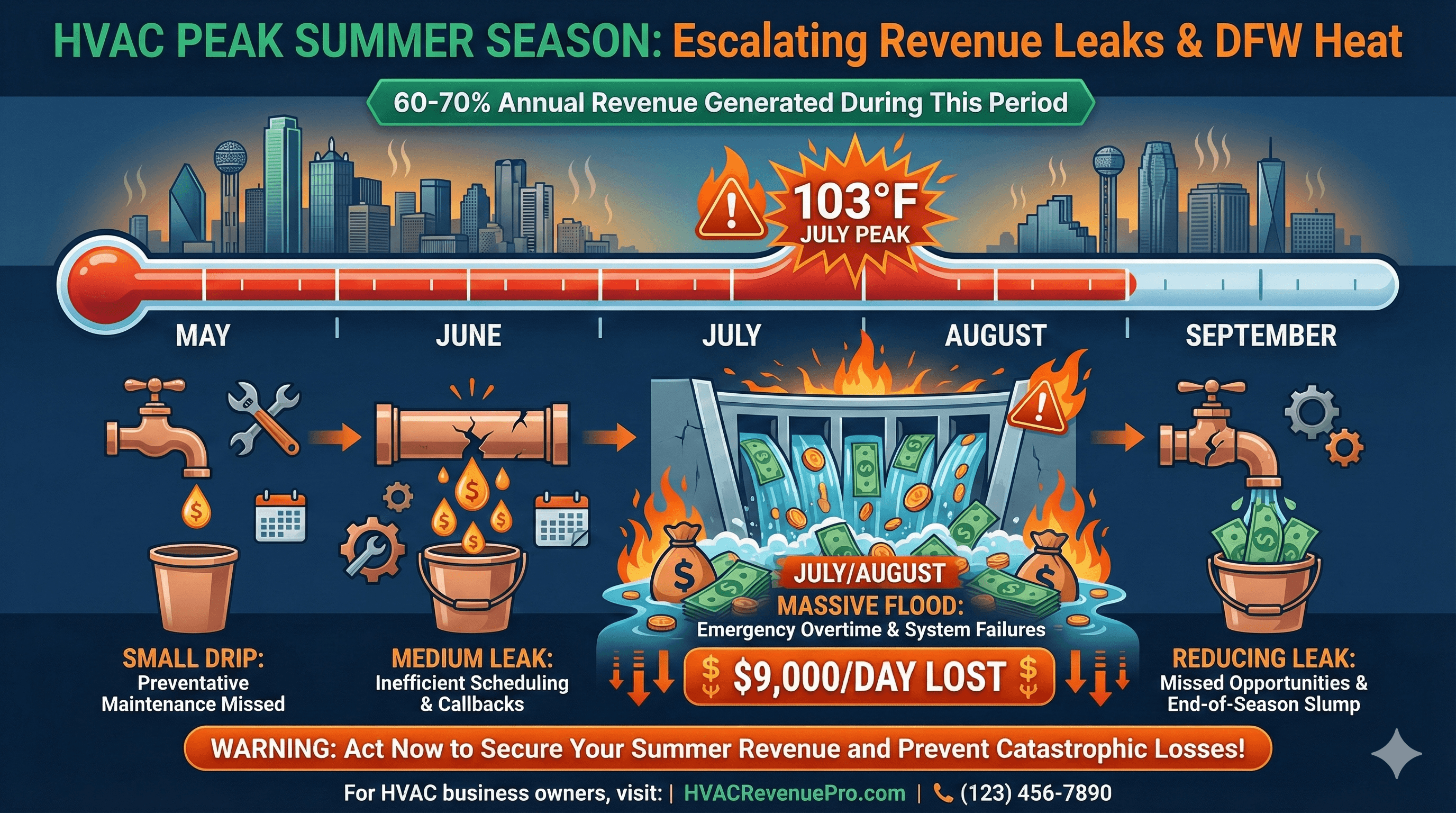
Peak season is when you make your year. 60-70% of annual revenue typically comes from those hot/cold months when homeowners NEED you immediately.
It's also when you lose the most revenue to operational breakdowns.
The Peak Season Paradox
The more calls you get, the more you miss. During off-season, most DFW HVAC companies answer 85-90% of inbound calls. During peak season? That drops to 60-70%. Higher volume + same staffing = more missed opportunities. And at peak season prices ($500+ emergency service calls), every miss hurts more.
Let's break down the four revenue leaks that compound during peak HVAC season—and what North Texas companies are doing to plug them before they bleed thousands.
Leak #1: Missed Calls Spike During High-Volume Windows
The Problem
It's 2pm on a 103-degree July afternoon. Your CSR is on call #1, call #2 is on hold, call #3 rings... and goes to voicemail. The homeowner with the broken AC immediately calls the next company. Your competitor answers. They book the $875 emergency service call. You never knew it existed.
Off-season vs. Peak Season Call Volume:
| Season | Daily Calls | Missed Calls | Lost Revenue/Day |
|---|---|---|---|
| Off-Season (April) | 15-20 calls | 2-3 (10-15%) | $700-1,050 |
| Peak Summer (July) | 50-80 calls | 15-24 (30%) | $7,500-12,000 |
| Peak Winter (January) | 40-60 calls | 10-18 (25%) | $5,000-9,000 |
The Peak Season Compounding Effect: That 10-15% off-season miss rate becomes 25-30% during peak. On a 90-day summer season with 60 daily calls at $500 average:
60 calls/day × 30% missed = 18 missed calls/day
18 missed × $500 average = $9,000 lost/day
$9,000/day × 90 days = $810,000 in missed peak season revenue
How North Texas HVAC Companies Are Solving This:
- Peak Window Analysis: Identify exactly WHEN calls spike (usually 11am-1pm, 3pm-6pm) and staff accordingly
- Overflow Staffing: Temporary CSRs during peak months
- AI Answering Backup: After-hours and overflow coverage for calls CSRs can't reach
- Real-Time Alerts: Get notified within 30 minutes if missed call rate spikes, adjust coverage immediately
Leak #2: Callback Times Slow Down When Speed Matters Most
The Problem
During off-season, your CSRs can call leads back within 10-15 minutes. During peak season? They're handling back-to-back calls, dispatching techs, managing emergencies. That 10-minute callback becomes 90 minutes. By then, the homeowner has already booked with the faster competitor.
The Peak Season Callback Slowdown:
DFW Market Data
- Off-Season Average: 12-18 minute callbacks, 55-65% conversion rate
- Peak Season Reality: 45-90 minute callbacks, 25-35% conversion rate
- Competitive Advantage Window: Callbacks under 20 minutes = 3x higher conversion during peak demand
Why This Matters More During Peak Season:
Off-season, a homeowner might wait 2 hours for a callback because their issue isn't urgent. Peak season? Their AC died, it's 98°F inside, and they have kids/elderly parents/pets suffering. They're calling every HVAC company in Dallas until someone responds FAST.
60% of homeowners book with whoever responds first during emergency situations. Speed isn't a nice-to-have—it's the primary competitive advantage.
How to Maintain Speed During Peak Surges:
- Dedicated Callback Person: One CSR focused only on new lead callbacks (not also dispatching/scheduling)
- Automated Callback Reminders: Alert when leads haven't been contacted within 15 minutes
- Text-First Strategy: Immediate text acknowledgment while working on callback ("We got your request, calling you within 10 min")
- Callback Time Benchmarking: Track daily average, compare to off-season baseline, staff up when it degrades
Leak #3: Estimate Follow-Up Falls Through the Cracks
The Problem
Your techs are running system diagnostics all day during peak season. Estimates flying out left and right: $6k system replacement, $4.5k duct work, $8k full install. Homeowners say "let me think about it." During off-season, CSRs have time to systematically follow up. During peak season? Those estimates sit idle while everyone fights fires.
The Peak Season Estimate Explosion:
| Season | Estimates/Week | No Follow-Up | Lost Opportunity |
|---|---|---|---|
| Off-Season | 8-12 | 2-3 (20-25%) | $14k-21k/week |
| Peak Season | 30-50 | 15-25 (50%) | $105k-175k/week |
Why Follow-Up Matters More During Peak Season:
During peak season, homeowners are getting estimates from 3-5 HVAC companies. They're comparing prices, availability, financing. The company that follows up within 2-3 days has a massive advantage—not because their price is lower, but because they demonstrated they actually want the business.
Most DFW HVAC companies send the estimate and... nothing. The homeowner assumes you're too busy to care about their $7k job. They book with the company that called to "check in" and offer to answer questions.
Case Study: Plano HVAC Company
During summer 2024 peak season, this company sent 187 estimates totaling $1.2M. 92 estimates (49%) received zero follow-up activity. Of those 92:
- → 34 were booked by competitors (confirmed via customer surveys)
- → 23 were still undecided and receptive when finally contacted
- → 35 had moved on and couldn't be reached
Lost revenue from lack of follow-up: Estimated $220k+ in that single peak season.
Peak Season Estimate Follow-Up System:
- Automated 3-Day Alert: If estimate hasn't been followed up within 72 hours, alert CSR
- Tiered Follow-Up Schedule:
- Day 2: "Any questions about the estimate?"
- Day 5: "Wanted to check in. Can we schedule the install?"
- Day 10: "Before we close this estimate, any final questions?"
- Peak Season Financing Promo: "If you book this week, we can offer 0% financing" (creates urgency)
- Weekly Estimate Review: Every Monday, review all estimates >7 days old, assign follow-up owner
Leak #4: CSR Burnout Leading to Quality Drops
The Problem
Your CSRs handled 20 calls/day during off-season without breaking a sweat. Now it's peak July, they're handling 50-60 calls/day, phones never stop ringing, every caller is stressed because their AC is broken. By week 8 of peak season, your best CSR is exhausted, making mistakes, and conversion rates are dropping—not because they're bad at their job, but because humans have limits.
The Invisible Cost of CSR Burnout:
- Slower call handling (trying to rush, making errors)
- Lower conversion rates (too exhausted to sell effectively)
- Increased mistakes (wrong addresses, missed notes, booking errors)
- Higher turnover (CSRs quitting mid-peak season = chaos)
North Texas Peak Season Reality: Most DFW HVAC companies run skeleton CSR crews during off-season, then try to power through peak season with the same staffing. It works... until it doesn't. Usually around week 6-8 of sustained high volume, quality starts degrading.
The Revenue Impact of CSR Quality Degradation
When CSR conversion rates drop from 65% to 45% due to burnout/exhaustion during peak season, and you're handling 60 calls/day at $500 average: 12 lost conversions/day × $500 × 90 days = $540,000 in revenue walked away just from quality degradation—not even counting the fully missed calls.
How to Prevent CSR Burnout During Peak Season:
- Seasonal Staffing Surge: Hire 1-2 temporary CSRs for peak months. Yes, they need training. Yes, it's an upfront cost. But losing $500k+ to burnout-driven quality drops costs way more.
- Shift Rotation: Instead of 8-hour slogs, consider split shifts during peak windows (cover 11am-1pm and 3pm-6pm heavy call times with fresh staff)
- AI Overflow Coverage: Use AI answering services for after-hours and overflow, so CSRs aren't working 10-12 hour days just to keep up
- Quality Monitoring: Track conversion rates weekly. If they drop below baseline, it's an early warning signal to add support
- Peak Season Bonuses: Incentivize strong performance during the hardest months. Happy, motivated CSRs = better conversion rates
Peak Season Stress Doesn't Just Affect CSRs
While CSR burnout impacts conversion rates, technician burnout drives $30K-50K turnover costs. Peak season stress is the #1 contributor to tech turnover in North Texas. Learn about the 7 retention metrics that predict tech turnover before you lose your best people.
The Pre-Peak Season Audit Strategy
Here's what smart North Texas HVAC companies are doing BEFORE peak season hits:
8 Weeks Before Peak Season Checklist
Run a 7-day revenue leak audit
Identify current baseline: missed calls %, callback times, estimate follow-up rate
Analyze last year's peak season data
What were call volumes? When did CSRs get overwhelmed? Where did quality drop?
Calculate staffing needs
If calls double, can your current team handle it? If not, hire seasonal support NOW
Set up automated monitoring
Daily alerts for missed calls, slow callbacks, idle estimates—catch issues before they compound
Define peak season KPIs
Target: <20 min callbacks, <10% missed calls, 100% of estimates followed up within 3 days
Implement overflow backup
AI answering service, answering service, or on-call backup CSRs for surge moments
Train seasonal staff early
Don't wait until week 1 of peak to onboard. Get them trained in April for May surge
Test systems under load
Can ServiceTitan/Housecall Pro handle 3x call volume? Do you have backup if systems slow?
The Peak Season Revenue Recovery Opportunity
Here's the upside: Peak season is when small operational improvements create massive revenue impact.
Related Reading: Beyond missed calls and callbacks, internal operational waste compounds during peak season. Discover the 5 dispatch inefficiencies costing $3K-8K monthly that get even worse when call volume triples.
During off-season, improving your callback time from 20 minutes to 10 minutes might convert 2-3 extra jobs/week. During peak season? That same improvement converts 15-20 extra jobs/week.
The math:
Peak Season Opportunity:
Reduce missed calls from 30% to 15% = 9 more calls answered/day
Improve callback time = +10% conversion rate
Add estimate follow-up system = convert 30% of idle estimates
Prevent CSR burnout = maintain 60%+ conversion rates
Combined Impact: $150k-300k additional revenue recovered during 90-day peak season
This is why North Texas HVAC companies that prepare for peak season outperform those that just "try to survive" it.
Next Step: Get Your Pre-Peak Season Audit
If you're reading this in March/April (pre-summer) or September/October (pre-winter), you have time to plug the leaks before peak season crushes your operations.
Here's what a pre-peak season audit shows you:
- Current baseline: Your off-season missed call %, callback times, estimate follow-up rate
- Peak projections: Based on last year's data, what to expect when call volume triples
- Staffing gaps: Where you'll be underwater if you don't add support
- Revenue at risk: Estimated losses if operational quality degrades during peak
- Action plan: Specific steps to take in next 30/60/90 days before surge hits
Best time to do this: 8 weeks before peak season starts. Gives you time to hire seasonal staff, implement monitoring, and stress-test systems before the flood.
Prepare for Peak Season Before It's Too Late
Get a free pre-peak season audit. We'll analyze your current operations, project peak season stress points, and show you exactly where to shore up before call volume triples.
Get Your Pre-Peak Season Audit100% free. Specific to North Texas seasonal patterns. Delivered in 7 days.
Related Articles
Why North Texas HVAC Companies Lose $20k+/Month
The 4 operational blind spots causing invisible revenue leaks in DFW HVAC businesses year-round.
ServiceTitan Monitoring vs. Replacement
Should you migrate off ServiceTitan or add monitoring? Understanding the critical difference.
About North Texas Operations: We help DFW HVAC companies prepare for peak season by identifying revenue leaks before they compound. Get your operations audit 8 weeks before summer/winter surge. See exactly where you'll be vulnerable when call volume triples. 100% North Texas focused.