
Why North Texas HVAC Techs Quit (And the $40K+ Replacement Tax): The Retention Metrics You're Not Tracking
You finally found a great technician. Spent 6 months training them on your systems, your customers, your way of doing things. They're hitting their stride. Then they give notice. Two weeks later, they're gone—along with $30,000-$50,000 you didn't realize you just lost.
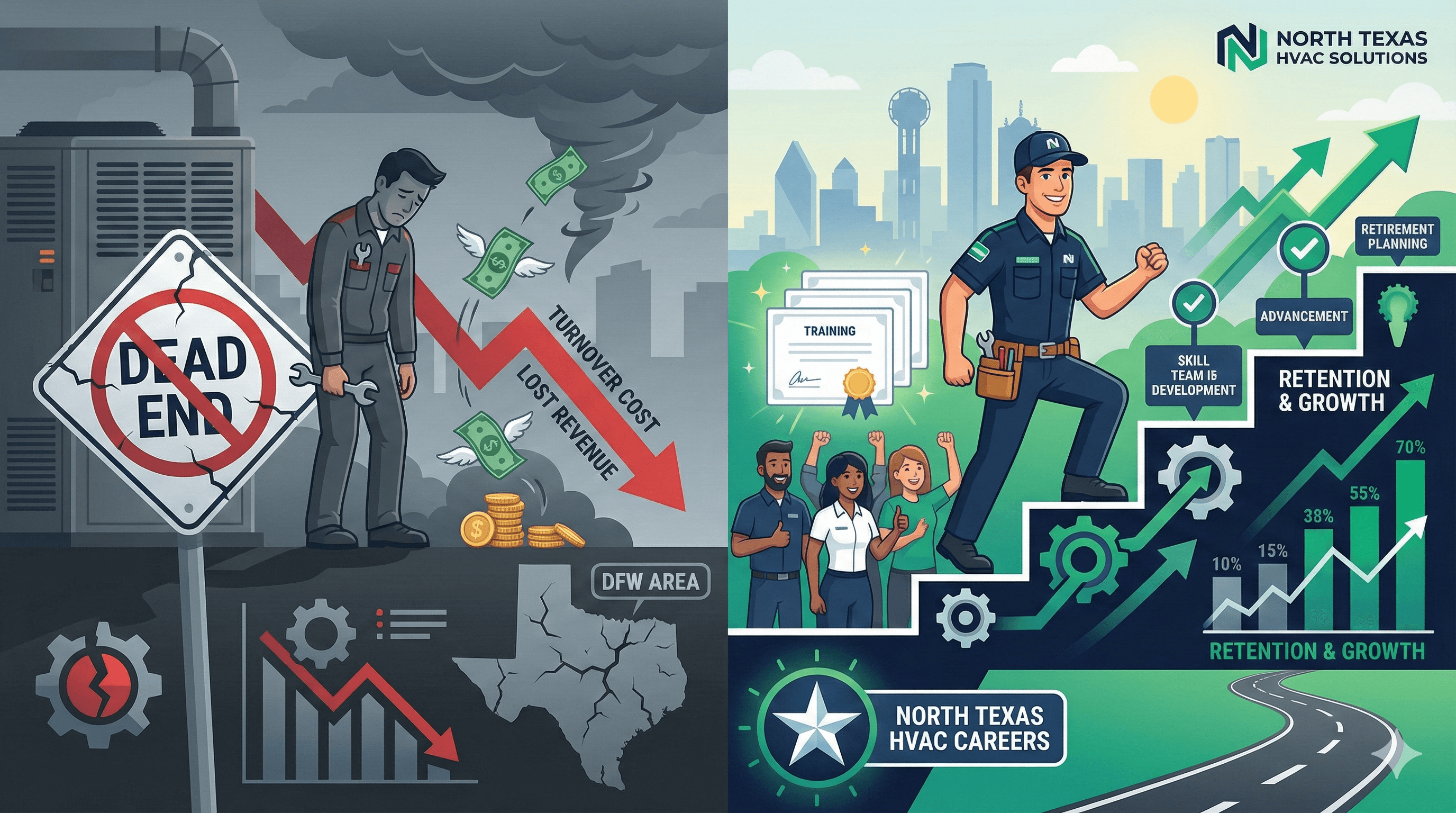
The Technician Crisis Nobody's Talking About
You're not alone. Across the HVAC industry, 25,000+ skilled technicians leave annually. Only 2 new techs enter the field for every 5 who retire. There are over 100,000 unfilled HVAC technician positions nationwide right now.
But here's what makes it worse for North Texas contractors: you're competing with 500+ other HVAC companies in the DFW metroplex for the same shrinking talent pool. When your tech quits, they're not leaving the industry—they're working for your competitor down the street, probably for $2/hour more.
The Hidden Turnover Tax
Here's the math you probably haven't done:
- $5K recruiting costs (ads, screening, interviews)
- $10K training investment (time, materials, reduced productivity)
- $8K lost productivity during 6-month ramp-up
- $4K customer impact (lost relationships, higher callbacks)
Total: $27K-$35K per technician replacement
For a 5-truck operation losing just ONE tech annually, that's the equivalent of an entire truck's quarterly profit margin burned on turnover alone.
What Replacing a Technician Actually Costs (It's Not Just Salary)
Most HVAC owners underestimate turnover costs by 60-70% because they only count recruiting and base salary. The real cost is buried in productivity loss, training time, customer impact, and team morale.
The 5 Hidden Turnover Costs
1. Recruiting & Hiring: $3,000-$5,000
- Job board ads and recruiting services ($500-1,000)
- Screening time: 20+ hours at $50/hour = $1,000
- Interview process: 8 hours owner time + tech panel time
- Background checks, drug testing, onboarding admin ($200-300)
2. Training & Onboarding: $8,000-$12,000
- Formal training time: 80 hours × $85 loaded rate = $6,800
- Training materials and certifications: $1,200
- Reduced productivity during training (they're learning, not earning)
- Mentor tech's diverted time from revenue work
3. Lost Productivity: $6,000-$10,000
New techs take 6 months to reach full productivity. During ramp-up, they average 65% of senior tech productivity.
35% productivity gap × $85/hour × 1,000 hours = $29,750 lost capacity. That's 3-4 additional jobs monthly you can't take because your new tech isn't up to speed yet.
4. Customer Impact: $2,000-$5,000
- Lost customer relationships (techs build loyalty over time)
- Higher callback rates from inexperienced replacements
- Customers asking for "their usual tech" who no longer works there
- Risk of losing high-value maintenance contracts tied to specific tech
5. Team Morale Hit: Unquantifiable But Real
- Remaining techs pick up the slack (overtime fatigue)
- "Is this place unstable?" doubt creeps in
- Training burden falls on senior techs (diverts from revenue work)
- Lost institutional knowledge and team chemistry
Case Study: McKinney HVAC Contractor (8 techs)
The Problem: Lost 3 technicians within 12 months (38% annual turnover rate)
Total Turnover Cost: $105,000+ in recruiting, training, and lost productivity
"We thought it was normal churn," the owner said. "We had no idea we were burning $100K annually on turnover we could have prevented. That's more than we spent on marketing that year."
The 7 Real Reasons Techs Leave (It's Not Always About Money)
Exit interviews across hundreds of HVAC companies reveal a consistent pattern: money ranks #5-7 on the list of why technicians quit. The top reasons are things you can actually fix—often for less than it costs to replace one tech.
Reason #1: Lack of Career Growth Visibility
The Problem: Techs don't see a path forward. They feel stuck. "Am I just going to run service calls for the next 20 years?"
What Techs Want: A clear progression. Apprentice → Tech → Senior Tech → Lead Tech → Supervisor. With timeline expectations (e.g., "Most techs reach Senior level in 2-3 years") and visible criteria for each level (certifications, performance benchmarks).
North Texas Pattern: DFW's booming construction and commercial sectors offer techs opportunities to jump to facilities management or corporate roles. If contractors don't provide growth paths, other industries will.
Solution:
- Create a documented career ladder with specific criteria
- Share it during onboarding
- Review progress quarterly in 1-on-1s
- Make promotion criteria transparent (no "wait your turn" ambiguity)
Reason #2: Inconsistent or Inadequate Training
The Problem: Techs are thrown into complex jobs without proper preparation. "Figure it out" isn't training—it's abandonment.
What This Looks Like: New hire sent on VRF system install with minimal training. No standardized onboarding program. Learning by trial and error (expensive errors). Techs feel incompetent and anxious.
The Data:
Companies investing in structured training see 30-50% retention improvement plus 24% higher profit margins (better first-time fix rates, faster job completion, fewer callbacks).
North Texas Reality: Texas summers mean no room for error on AC installs. Inadequate training = callbacks = frustrated customers = stressed techs = turnover cycle.
Solution:
- 80-hour structured onboarding program (not "shadow someone for a week")
- Monthly lunch-and-learn sessions (new products, troubleshooting)
- Quarterly manufacturer certifications
- Budget $5K-10K per tech annually for training
Reason #3: Poor Work-Life Balance / Burnout
The Problem: On-call rotation burnout, excessive overtime, missing family events repeatedly. "You're never home" becomes family resentment.
North Texas Summer Reality: June through September, 100°F+ temps = emergency call surge. Techs working 60-70 hour weeks for months. Weekend on-call rotation with no recovery time.
The Burnout Cycle:
- Peak season hits → All-hands-on-deck mentality
- No staffing buffer → Techs work unsustainable hours
- Exhaustion and resentment build over months
- Best techs quit (they have options)
- Remaining techs carry even heavier load
- Repeat cycle gets worse
Warning Signs: Same 2-3 techs always on call (uneven burden distribution). Mandatory overtime every week. Techs not using PTO. Weekend work without compensatory time off.
Solution:
- Predictable schedules (2 weeks advance notice)
- Fair on-call rotation with mandatory recovery time
- Mandatory PTO usage (prevent burnout banking)
- Hire seasonal support for peak periods
- Premium pay for weekend/evening on-call (20%+ bump)
Reason #4: Lack of Recognition / Feeling Undervalued
The Problem: Only hear feedback when something goes wrong. No acknowledgment of going above and beyond. Feel like "just a number."
What Techs Say in Exit Interviews:
- • "I worked my ass off and never heard 'thank you'"
- • "Only time I heard from management was when a customer complained"
- • "They notice when you're 5 minutes late but not when you work 2 hours past close"
The Recognition Gap: High performers need validation. Without it, they assume you don't value them—so they find someone who will.
Solution:
- Monthly top performer recognition (public acknowledgment + bonus)
- Performance bonuses tied to customer satisfaction and efficiency
- Quarterly team meetings with owner face time
- Regular 1-on-1s (not just annual reviews)
- Celebrate wins, not just criticize losses
Reason #5: Tools & Equipment Frustrations
The Problem: Old, unreliable trucks. Missing or outdated tools. Having to buy own equipment.
What This Signals to Techs: "We don't invest in our team. We're cheap." When a truck breaks down twice per month or critical diagnostic tools are missing, techs feel disrespected.
North Texas Reality: DFW's geographic spread (9,286 square miles) means reliable trucks are critical. Breaking down on I-35 during rush hour wastes hours and creates massive frustration.
Solution:
- Regular truck maintenance and replacement cycles (200K mile max)
- Proper tool stipends or company-provided tool sets
- Modern tablets/phones for mobile invoicing
- Well-stocked trucks (reduce emergency parts runs)
Reason #6: Dispatch & Routing Inefficiencies
The Problem: Techs waste 90 minutes daily driving inefficient routes. Feels disrespectful of their time.
Connection to Operations: Dispatch inefficiency doesn't just drain profit margins—it burns out technicians. When techs spend more time in traffic on I-35 than working on systems, they feel like their skills are being wasted. Learn more about the 5 dispatch inefficiencies costing $3K-8K monthly and how they contribute to tech frustration.
What Poor Dispatch Does: Plano job → Arlington job → back to Frisco = 2+ hours wasted drive time. Rushed jobs due to poor time allocation. Late arrivals (customer frustration trickles to tech). Overtime not from work volume but from inefficiency.
Solution:
- Geographic dispatch zones (keep techs in their area)
- Route optimization software
- Morning dispatch planning (cluster jobs by location)
- Realistic time estimates (don't overbook)
Reason #7: Compensation Not Competitive
The Reality: Money IS a factor, but usually #5-7 on the list. Most techs who quit for "more money" are really leaving because of reasons #1-6, and the higher salary elsewhere is just the final justification.
DFW Market Rate Awareness: Techs know what competitors pay (word spreads fast in the tight-knit HVAC community). If you're paying $5K below market, they know it—and resent it.
North Texas Wage Benchmarks (2026):
- Entry-level tech: $45K-55K base
- Mid-level tech (2-4 years): $55K-70K base
- Senior tech (5-8 years): $70K-90K base
- Lead tech / Supervisor: $80K-110K base
- Plus: Performance bonuses, commission on sales, benefits
Solution:
- Annual market rate reviews (don't fall behind)
- Performance-based bonuses (not just revenue-based)
- Tiered pay structure tied to career levels
- Transparent commission structure (no surprises)
The 7 Retention Metrics You Should Be Tracking
Most HVAC contractors track revenue, job count, and customer satisfaction. But if you want to predict technician turnover before it happens, you need to track these 7 retention metrics.
Metric #1: Tech Tenure Trend
What to Track: Average tenure by tech, year-over-year trend
Warning Sign: Tenure declining annually (e.g., average dropping from 5 years to 3 years)
Benchmarks:
- Industry Average: 3-5 years
- North Texas Goal: 5+ years average tenure
- Excellent: 8+ years
Metric #2: Training Hours Per Tech Annually
What to Track: Formal + informal training time per tech
Warning Sign: <40 hours/year per tech
Benchmarks:
- Minimum: 40 hours annually
- Industry Standard: 60-80 hours
- Leading Companies: 100+ hours
ROI Connection: Training hours correlate directly with retention rates. Companies investing 80+ hours annually see 30-50% better retention.
Metric #3: Tech Performance Variance
What to Track: Job completion time, callback rate, customer satisfaction by tech
Warning Sign: Wide variance between techs (indicates training gaps or struggling techs)
Action: Identify struggling techs early, provide targeted support before frustration builds and they quit.
Metric #4: On-Call Burden Distribution
What to Track: How evenly on-call rotation is distributed across team
Warning Sign: 2-3 techs carry 70% of on-call load
Burnout Predictor: Same techs always working weekends/holidays
Target: Equal distribution with mandatory recovery time after weekend emergencies
Metric #5: Time-to-Full-Productivity
What to Track: How long until new tech performs at team average
Warning Sign: 9-12 months (should be 4-6 months)
What It Indicates: Training program effectiveness. Slow ramp-up = inadequate onboarding or poor mentorship.
Metric #6: Tech Satisfaction Score
What to Track: Quarterly 1-on-1 check-ins, anonymous surveys
Warning Sign: Declining satisfaction trend
Questions to Ask:
- How do you feel about your career growth here?
- Is training adequate for your role?
- How's your work-life balance?
- Do you feel valued and recognized?
Frequency: Quarterly pulse checks, annual comprehensive survey
Metric #7: Exit Interview Patterns
What to Track: Why techs actually leave (document specific reasons)
Warning Sign: Same reasons appearing repeatedly (e.g., 3 of last 5 exits cite "no growth path")
Action: Address systemic issues, not just individual cases. If multiple techs leave for the same reason, you have a structural problem to fix.
How DFW HVAC Contractors Improved Retention
Case Study 1: Plano Residential HVAC (12 techs)
Baseline: 40% annual turnover (5 techs leaving per year)
Turnover Cost: $150K-200K annually
Changes Implemented:
- Created documented career ladder program
- Increased training investment to $30K annually (company-wide)
- Equipment upgrades (new trucks every 4 years, modern tools)
- Quarterly performance reviews with growth discussions
Result: Turnover dropped to 15% within 18 months, saving $100K+ annually
Bonus Impact: Customer satisfaction scores increased (tech consistency)
Case Study 2: Fort Worth Commercial Contractor (8 techs)
Problem: On-call burnout (3 techs carrying 80% of weekend load)
Symptoms: Two techs gave notice citing family strain
Changes Implemented:
- Mandatory on-call rotation policy (equal distribution)
- On-call premium pay increase (20% bump for weekend/evening)
- Recovery PTO after weekend emergency work (Monday off after Sunday call)
- Hired part-time on-call support for peak season
Result: Retention improved from 60% to 85%, tech satisfaction scores jumped 35%
Case Study 3: Frisco Full-Service HVAC (15 techs)
Problem: No career growth visibility
Symptoms: Losing techs to supervisor roles at other companies
Changes Implemented:
- Created Lead Tech role with clear promotion criteria
- Published career progression timeline and requirements
- Quarterly performance reviews with specific next-level targets
- Tuition reimbursement for advanced certifications
Result: 3 internal promotions to Lead Tech in 18 months, retention jumped from 65% to 90%
Recruiting Benefit: Now attract better candidates ("career growth opportunities" in job ads)
The 30-Day Technician Retention Assessment
You don't need expensive consultants. Here's how to audit your retention risks in 30 days:
Week 1: Baseline Data Collection
- Calculate actual turnover cost for last 2 years
- Survey current techs anonymously (10-question satisfaction survey)
- Review training hours per tech over last 12 months
- Identify tenure patterns (who's been here longest? shortest?)
Week 2: Performance Analysis
- Analyze job performance variance across team
- Identify top performers vs. struggling techs
- Review on-call distribution fairness
- Check callback rate by technician
Week 3: Exit Interview Review
- Pull all exit interviews from last 2 years
- Categorize reasons (growth, pay, burnout, training, management, other)
- Identify patterns (same issues recurring?)
- Talk to remaining techs: "What would make you leave?"
Week 4: Action Planning
- Identify top 2 retention risks (where are you most vulnerable?)
- Calculate ROI of addressing them (cost vs. turnover savings)
- Create 90-day improvement plan
- Set measurable targets (e.g., reduce turnover from 30% to 20%)
Quick Win Alert
Most contractors find their #1 retention risk is something they can fix in 30-60 days (better on-call rotation, clearer career path communication, equipment upgrades). You don't need to solve everything—just fix the biggest pain point first.
Why Training Investments Pay for Themselves
"Training is expensive." You know what's more expensive? Not training.
The Training ROI Calculator
Training Cost: $5K-10K per tech annually
- Monthly lunch-and-learns: $500/month = $6,000/year
- Quarterly manufacturer certifications: $2,000/year
- Annual advanced training (VRF, controls, etc.): $2K-5K
Training Benefits:
1. Callback Reduction: $8K-12K saved
40% callback reduction × $280 avg callback cost × 100 jobs = $11,200 saved
2. Faster Job Completion: $15K-20K capacity gain
15% time savings per job × 400 jobs × 0.5 hours × $85 rate = $17,000 additional capacity
3. Retention Improvement: $30K-45K turnover avoided
30-50% retention improvement = avoiding even ONE turnover = $30K-45K saved
Net ROI: 300-500% return on training investment
What to Train: Technical skills (new systems, troubleshooting), customer service, efficiency and time management, safety and compliance, sales and upselling.
The 5-Point Retention Plan for North Texas HVAC Contractors
Strategy #1: Create Visible Career Paths
The Framework: Apprentice (0-1 year) → Technician (1-3 years) → Senior Technician (3-5 years) → Lead Technician (5-7 years) → Supervisor/Manager (7+ years)
Clear Criteria for Each Level: Specific certifications required, performance benchmarks (callback rate, customer satisfaction, efficiency), timeline expectations, pay ranges for each level.
Communication: Share this ladder during onboarding and review progress quarterly.
Strategy #2: Invest in Ongoing Training
- Monthly: Lunch-and-learn sessions (new products, troubleshooting techniques)
- Quarterly: Manufacturer certifications (Trane, Carrier, Lennox)
- Annually: Advanced training (VRF systems, building controls, leadership)
- Budget: $5K-10K per tech annually
Strategy #3: Fair & Transparent Compensation
Components:
- Market-rate base salary (annual market review)
- Performance bonuses (efficiency, customer satisfaction, revenue)
- Tiered pay structure tied to career levels
- Transparent commission (clear calculation, no surprises)
Strategy #4: Work-Life Balance Protections
- Predictable schedules (2 weeks advance notice)
- Fair on-call rotation with recovery time
- Mandatory PTO usage (prevent burnout banking)
- Family-friendly policies (flexibility for school events, etc.)
- No-surprise overtime (scheduled in advance when possible)
Strategy #5: Recognition & Communication
Recognition Programs:
- Monthly top performer recognition (cash bonus or gift card)
- Quarterly team meetings (company updates, Q&A with owner)
- Annual awards (tenure recognition, top performer, customer favorite)
Communication Cadence:
- Weekly team huddles (5-10 minutes, operational updates)
- Monthly 1-on-1s with each tech (career discussion, feedback)
- Quarterly all-hands (company performance, strategic direction)
- Annual comprehensive review
How Operational Monitoring Supports Retention
Here's the connection most HVAC owners miss: operational monitoring isn't just about revenue—it's about protecting your team.
Real-Time Visibility Prevents Unfair Blame
System shows a job actually took 3 hours (not that the tech was slow). Data-driven coaching vs. "gut feeling" criticism. Objective metrics prove performance, protecting techs from unfounded complaints.
Performance Data Enables Fair Coaching
Clear benchmarks for what "good" looks like. Rewards top performers with data to back it up. Identifies struggling techs early so you can provide support before frustration builds and they quit.
Reducing Operational Chaos
Better scheduling reduces tech stress. Fewer last-minute emergency reassignments. Predictability improves work-life balance. When operations run smoothly, techs feel respected—not frazzled.
North Texas Operations' Role
We monitor operational efficiency not just to recover revenue, but to identify patterns that burn out your team. When dispatch inefficiency creates 2+ hours of daily waste, that's not just profit loss—it's tech frustration that leads to turnover. Our monitoring helps you see and fix these issues before they cost you your best people.
Ready to Stop Losing Your Best Techs?
Get a free 30-day retention assessment. We'll analyze your turnover patterns, identify your biggest retention risks, and show you exactly where to focus your improvement efforts.
No obligation. Most contractors discover $50K+ in annual turnover costs they can prevent.
Related Articles
The Hidden Labor Costs Killing HVAC Profits
Dispatch inefficiency doesn't just drain profits—it burns out technicians and drives turnover.
The 7 HVAC KPIs You're Not Tracking
Beyond revenue metrics, track these performance indicators that predict growth and retention.