
Not an Anti-ServiceTitan Article
ServiceTitan is the right choice for many operations — particularly those over 30 techs with complex multi-location needs. This article is about the contractors for whom it's not the right fit, and what the honest alternatives look like in 2026.
In 2019, ServiceTitan was the aspirational platform. If you ran a serious HVAC shop, you were either on it or working toward it. The brand carried a signal: this operator is professional, growth-minded, data-driven.
In 2026, that signal has gotten complicated.
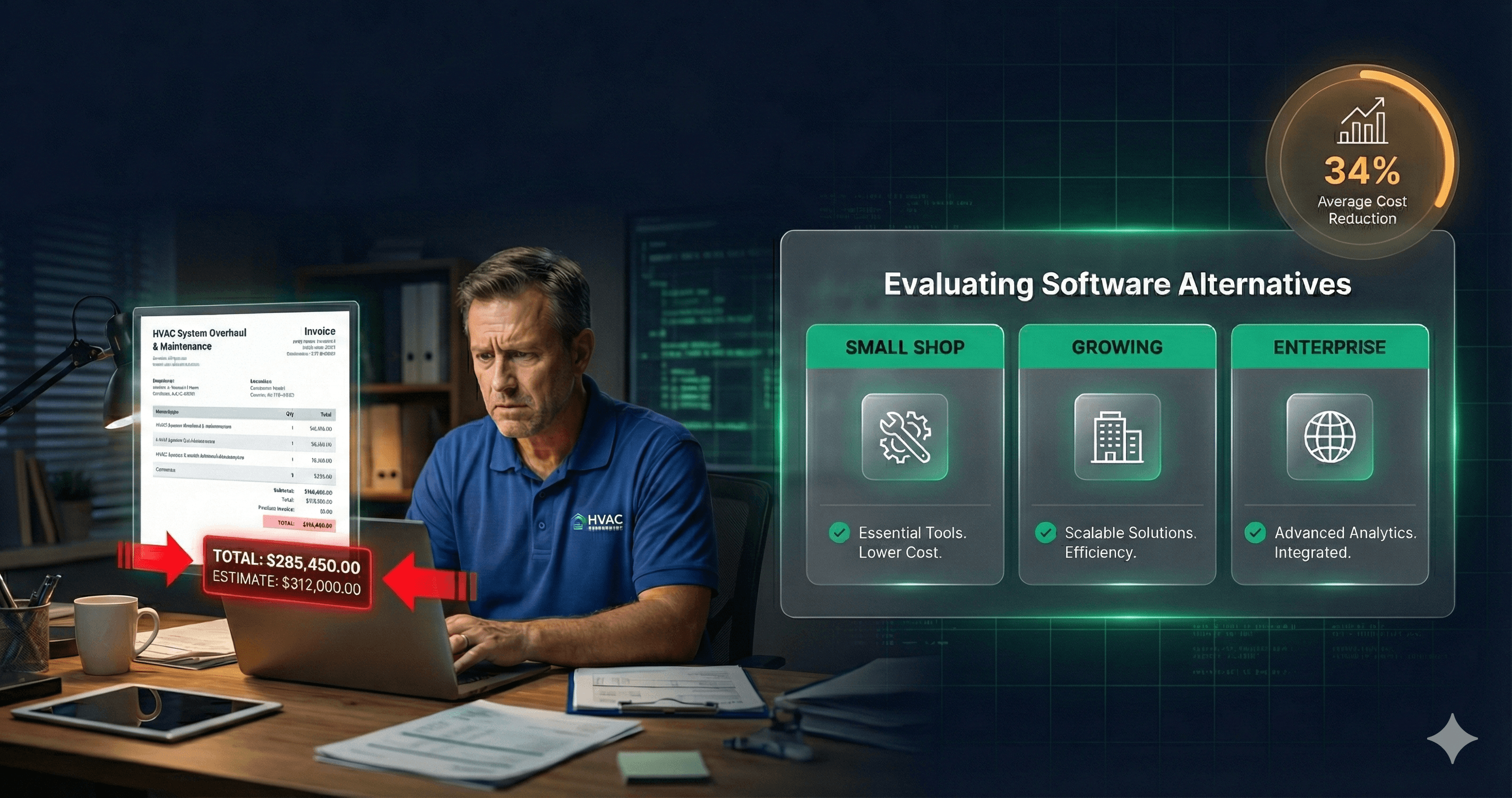
A software platform that costs $259,000–$353,000 annually for a 30-tech operation, takes 12–18 months to fully implement, and routes non-critical support tickets into a 3–5 day response queue is no longer the obvious choice for every contractor. And the market is responding. Industry surveys in 2025–2026 show 34% of current ServiceTitan users actively evaluating alternatives — not casually browsing, but running RFPs, attending demos, and in some cases mid-migration.
What's driving it, what the alternatives actually look like, and how to think through the decision — that's what this article is about.
What's Driving the Evaluation Wave
Cost Shock at Scale
$259K–$353K/yr
For a 30-tech operation, ServiceTitan licensing, add-ons, and required integrations routinely hit six figures annually. Many contractors didn't see this coming when they signed at 10 techs.
Implementation Delays
12+ months
Average full implementation time for mid-to-large shops has stretched to 12–18 months in 2025–2026. During that window, teams are running dual systems, training is ongoing, and productivity dips.
Support Quality Decline
#1 complaint in 2025
Response time for non-critical support tickets has stretched to 3–5 business days for standard tier accounts. Contractors accustomed to phone support have found the shift to ticketing frustrating.
Feature Bloat Without Fit
Avg. 61% features used
Most small-to-mid shops use fewer than two-thirds of ServiceTitan's features. They're paying for a platform built for 50+ tech operations when they're running 12.
The Cost Breakdown Most Contractors Don't See Coming
ServiceTitan's licensing starts reasonably — around $398/month for a very small shop on a base plan. The sticker shock comes from what gets added as you grow:
- Core platform license: $398–$898/month depending on tier
- Per-tech fees: $65–$95/tech/month as you scale
- Marketing Pro add-on: $400–$800/month
- Phones Pro (call tracking): $300–$600/month
- Dispatch Pro: $200–$400/month
- Implementation services: $15,000–$40,000 one-time
- Ongoing training and support fees: $200–$500/month
For a 30-tech operation using a full stack of ServiceTitan add-ons, total annual cost lands between $259,000 and $353,000. That's before considering the internal IT time required to maintain integrations, the productivity loss during the 12–18 month implementation window, or the cost of retraining staff when ServiceTitan releases major UI updates.
For a shop doing $4M in revenue, that's 6.5–8.8% of top-line revenue going to a software platform. At $8M revenue, it's 3.2–4.4%. The math gets better as you scale — which is exactly why ServiceTitan works well for 50+ tech operations and becomes harder to justify for 15–25 tech shops.
What a Fair Comparison Looks Like
The mistake most contractors make when evaluating alternatives is comparing feature lists. That's the wrong frame. The right question is: what does your operation actually need, and what does it cost to get just that?
Here's an honest breakdown by shop size:
- Fast setup (days, not months)
- Intuitive for non-technical owners
- Built-in customer communications
- No long-term contracts
Watch for: Limited reporting depth — outgrow it around 10 techs
- ServiceTitan feature parity on core ops
- 3–6 week implementation (vs. 12+ months)
- Responsive support at this price tier
- Strong dispatch and scheduling UI
Watch for: Thinner ecosystem of integrations vs. ST
- Purpose-built for multi-location ops
- Advanced reporting and forecasting
- Dedicated implementation teams
- API-first for custom integrations
Watch for: Higher switching cost — evaluate carefully before committing
The Migration Difficulty Scale
Every contractor who has switched FSM platforms will tell you the same thing: it was harder than they expected. Understanding why helps you plan for it honestly.
Data migration is the first hurdle. Your customer history, job records, equipment data, and agreement portfolio all need to move. Most platforms offer migration tooling, but the quality varies widely. Housecall Pro and Workiz have reasonably clean import tools for standard ServiceTitan exports. Enterprise platforms like Service Dynamics typically assign a dedicated migration team.
Team retraining is the second hurdle — and the one most contractors underestimate. Your CSRs, dispatchers, and techs have muscle memory built around ServiceTitan's UI. Expect 4–8 weeks of reduced productivity during the transition window regardless of how good the new platform is. Budget for this explicitly.
Integration rewiring is the third. If you've built your operations around ServiceTitan's integrations with your phone system, marketing tools, financing providers, or accounting platform, each of those connections needs to be re-established with the new platform. This is where timelines slip.
Rule of thumb: whatever your vendor quotes for implementation time, add 40%. Whatever they quote for cost, add 25%. Plan for the worst and celebrate the best.
When ServiceTitan Is Still the Right Answer
This would be an incomplete article without saying this clearly: ServiceTitan remains the most feature-complete FSM platform available. For the right operation, it's worth every dollar.
ServiceTitan makes sense if you are:
- Running 30+ techs with genuine multi-location complexity
- Scaling aggressively and need a platform that won't become the ceiling at 50 techs
- PE-backed or acquisition-minded — institutional buyers recognize and value ServiceTitan infrastructure
- Deeply integrated into ServiceTitan's marketing, financing, and reporting ecosystem after years of use
- Getting genuine ROI from advanced features like dynamic pricing, capacity planning, or the ServiceTitan marketplace
If none of those describe your current situation, you have a real conversation to have with yourself about whether you're paying for a platform you've grown into or one you're still growing toward.
The Decision Framework: 5 Questions to Ask Before You Switch
Before you commit to any platform change, get honest answers to these five questions:
1. What percentage of ServiceTitan features do you actually use?
Pull your usage report or ask your CSM. If it’s below 60%, you’re almost certainly over-platformed.
2. What is your all-in annual ServiceTitan cost including add-ons?
Don’t use the base license number. Add every module, integration fee, and support tier. Then compare that number to 1% of your annual revenue. If it’s above 4%, you have a real conversation to have.
3. What would a 6-month migration window cost in lost productivity?
Estimate a 15% productivity drop across your CSR and dispatch team during the transition. That’s your switching cost floor — the alternative needs to save you more than that annually to justify the move.
4. Are you switching toward something or away from something?
Frustration with ServiceTitan support is not a sufficient reason to migrate. You need a clear picture of what the new platform does better for your specific operation, not just what ServiceTitan does worse.
5. What happens to your data if the new vendor goes under?
Smaller FSM vendors carry real business risk. Ask about data export rights, file format ownership, and what the exit plan looks like if the vendor is acquired or shuts down.
What North Texas Contractors Are Actually Doing
In conversations with DFW HVAC operators in early 2026, a few patterns have emerged:
Shops in the 8–15 tech range are the most actively evaluating. Many got onto ServiceTitan during a growth phase and are now steady-state — not scaling fast enough to justify the full platform cost, not using the advanced features that justify the top tiers. Workiz and Housecall Pro are the most common destinations for this group.
Shops in the 15–30 tech range are more split. Some are doubling down on ServiceTitan — leaning into Marketing Pro, Phones Pro, and the capacity planning tools that genuinely differentiate it. Others are doing a hard cost-benefit analysis and finding that Workiz or a custom-configured simpler stack costs 40–60% less for 80% of the functionality they actually use.
Shops over 30 techs are largely staying put. The switching cost is too high, the integration complexity too significant, and the enterprise alternatives aren't meaningfully cheaper once you factor in implementation.
A Word on the Data Question
One concern we hear consistently from DFW contractors considering a switch: “What happens to my historical data?”
ServiceTitan allows data exports, but the format isn't always clean or complete. Customer history, job notes, and agreement records export reasonably well. Equipment history and custom fields are more variable. Before committing to any migration, request a full export of your current ServiceTitan data and validate that the new platform can ingest it correctly. Do this before you sign the new contract.
Vendors who won't let you validate data import before signing are a red flag.
The Bottom Line for DFW Contractors
ServiceTitan is not going anywhere, and it's not a bad platform. It's a very good platform for a specific type of contractor — one large enough to absorb the cost, complex enough to need the features, and growth-oriented enough to justify the infrastructure investment.
If that's not you today — if you're running a tight 10–20 tech operation, using 60% of the platform, paying six figures annually, and watching support tickets sit for 3 days — you have a legitimate reason to evaluate your options.
Do it carefully. The switching cost is real. But so is the cost of staying on a platform that no longer fits.
A 14-Tech Frisco Shop's Switch from ServiceTitan to Workiz
A Frisco-based HVAC contractor with 14 techs and $3.2M in revenue spent $187,000 on ServiceTitan in 2024 including all add-ons. After auditing their actual feature usage (58% of available modules), they ran a 90-day Workiz pilot alongside ServiceTitan in Q3 2025. Their findings: Workiz handled 94% of their day-to-day workflows. Full migration completed in January 2026. Annual platform cost: $41,400 — a $145,600 annual reduction. They redirected $60K of those savings into a second dispatcher and a CSR performance bonus program.
Annual platform cost
Features used
Implementation time
Related Articles
North Texas Operations
We help DFW HVAC contractors identify and recover revenue leaks through operational monitoring and data analysis. Our clients stop leaving money on the table — without adding headcount or overhauling their tech stack.